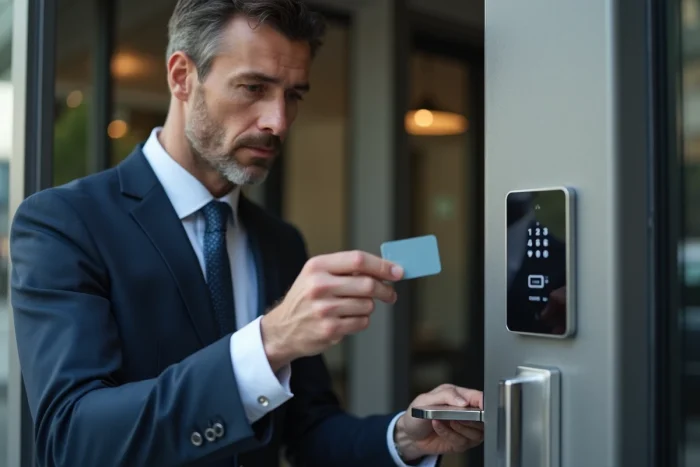
Biometrics do not guarantee the infallibility of an access control system. However, the widespread use of magnetic badges still exposes many companies to intrusions. Regulations are evolving faster than the equipment installed in most commercial buildings.
Between the dematerialization of identifiers and the proliferation of connected objects, access security solutions are diversifying at a rapid pace. Some recent technologies, already adopted in sensitive sectors, are setting new standards for the protection of professional premises.
Why access management is a strategic issue for the security of professional premises
Access management shapes the response of companies to the rise of risks, whether they come from the inside or outside. An unattended door, a misplaced badge, an outdated device: each vulnerability opens the door to intrusions and undermines the trust that is essential for the protection of professional premises. It is not just about preventing theft or damage. Behind every poorly managed access, it is also the safety of data, the confidentiality of industrial processes, and the protection of teams that are at stake.
In the face of these challenges, one question arises in management: how to restrict access to only authorized individuals without turning every passage into an obstacle course? Next-generation access management solutions combine precise identification, traceability, and adaptability. Centralized rights management, biometric authentication, connected devices: each technological advancement reduces the exposure surface without burdening daily operations. The level of security can thus be finely adjusted according to the profiles and spaces concerned, to stay in line with the ever-evolving threats.
The choice of partners and providers is not made lightly. Specialized players, such as xter.fr, share analyses and feedback: all valuable assets for building a solid security strategy and deploying tailored solutions. Mastering local access then becomes a significant asset, at the heart of each company’s performance and reputation.
Which access control systems to choose: overview of physical, digital, and hybrid solutions
Access control has evolved significantly since the days of traditional keys. To enhance the security of their professional premises, companies now have a wide range of control systems to choose from. There are various physical devices that constitute the first layer of protection:
- Magnetic badges and cards, widely used and easy to manage on a daily basis
- Electronic cylinders, allowing access modulation without changing all the hardware
- Card readers, which facilitate precise rights management without excessive complexity during system installation
Alongside these proven solutions, digital access control systems are gradually gaining ground. Access via smartphone, biometrics, facial or fingerprint recognition: each innovation raises the level of secure access control. These digital tools stand out for their traceability and centralized management, allowing for quick responses in case of team changes, new providers, or visitors.
In practice, hybridization is expanding. Many access control solutions now combine robust physical devices with flexible digital platforms. This alliance meets specific needs: protecting sensitive areas, monitoring flows, managing remotely. Each business context can thus benefit from a tailored solution that optimizes control implementation without constraining users.
The success of an access control system depends on a balance between the level of risk, internal organization, and expectations regarding management solutions. Investing in modular and scalable technologies means equipping oneself for effective and sustainable protection of professional spaces.

Innovations transforming corporate security: trends and perspectives to know
Innovative solutions are shaking up the codes of access management in companies, driven by an unprecedented technological acceleration. The combination of electronics, artificial intelligence, and data management opens up new avenues. Today, the protection of professional premises is no longer limited to locking a door: it is about orchestrating a living strategy that evolves with usage and risks.
Overview of major trends
Here are the major developments currently underway in the sector:
- Intelligent automation: centralizing access on connected platforms allows for anticipating needs and reacting in real-time to the slightest anomaly, ensuring optimal responsiveness.
- Behavioral analysis: some systems use algorithms capable of detecting unusual behaviors, providing proactive monitoring where the context demands it.
- Interoperability: management devices are now designed to integrate with other systems (video surveillance, fire alerts), enhancing the coherence and effectiveness of the overall system.
The deployment of innovative solutions for access management and the security of your professional premises is gaining traction across all sectors, from tertiary to industry, whether at the national or local level, in Bordeaux or elsewhere. Security managers favor tailored tools that can support the company’s growth and adapt to evolving risks. The ability to finely adjust access rights, trace each event, and strengthen sovereignty over data: all levers to maintain the balance of organizations and offer more freedom of movement to employees. The boundaries between security and agility are fading, shaping the future of protected work without unnecessary constraints.