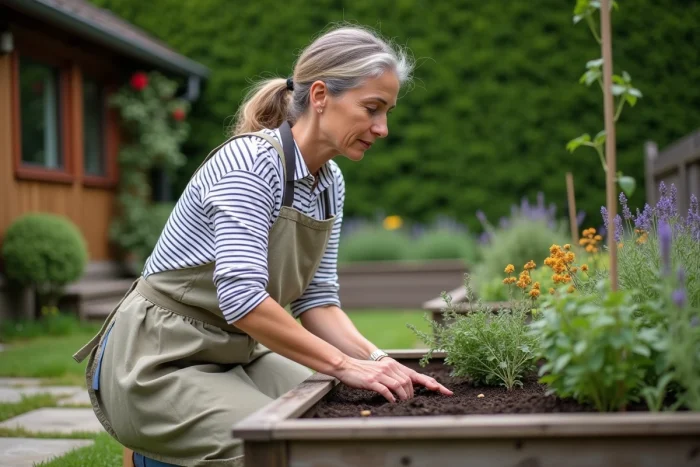
A garden that remains pleasant without requiring attention every weekend demands technical choices made in advance, not just a collection of decorative tips. The topic of a harmonious and easy-to-maintain garden frequently arises in searches, but most guides merely list “easy” plants without addressing the design logic that, alone, sustainably reduces the workload.
This article explores three structural axes: grouping by water needs, the role of grass in a tense climatic context, and the role of plant layers in visual coherence.
Grouping plants by water needs to simplify watering
The majority of private gardens mix plants with opposing requirements in the same bed. A water-hungry hydrangea coexists with a lavender that fears stagnant moisture. The result: uniform watering that drowns some and dries out others, leading to constant corrective maintenance.
Organizing planting areas according to water and sunlight needs changes the game. On the Jardin Jade website, this approach of “needs zones” is described as a concrete lever to streamline maintenance and limit water waste, an increasingly valid argument in light of summer drought episodes.
Specifically, this involves mapping out three or four zones, each corresponding to a distinct watering regime:
- A dry zone, in full sun, reserved for Mediterranean plants or drought-tolerant perennials (rosemary, gaura, yarrow, grasses like stipa)
- An intermediate zone, in partial shade, for long-flowering shrubs and ground covers (perennial geraniums, heucheras, brunnera)
- A cool zone, near a water source or in a low area of the terrain, where more demanding plants naturally find the moisture they need
This division reduces watering trips, simplifies the installation of drip irrigation, and limits dosage errors. Grouping plants by water needs reduces water consumption and maintenance time.
Reduced or eliminated lawn: a design choice for an easy garden
Grass remains the most time-consuming surface in a garden. Regular mowing, frequent watering, scarifying, weeding: the classic lawn accounts for the majority of annual maintenance hours. Increasingly common water restrictions in summer exacerbate the problem, as unwatered grass yellows in just a few days and loses all aesthetic function.
Several alternatives exist to replace all or part of the lawn without sacrificing visual harmony.
Ground covers and mineral surfaces
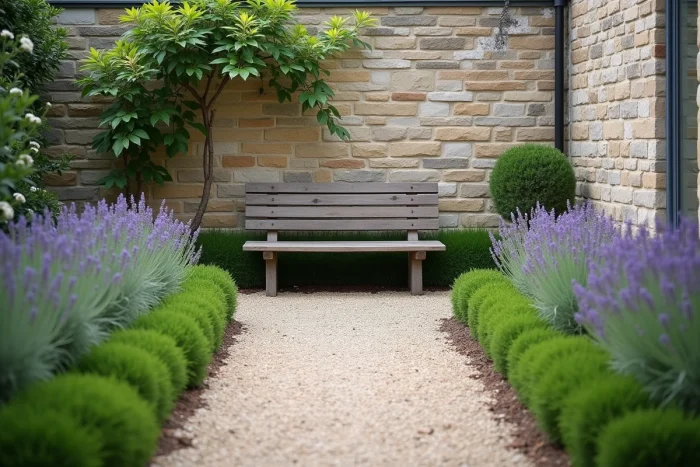
Thyme, sedum, or periwinkle form dense mats that require neither mowing nor regular watering. These ground cover plants suppress weeds and maintain a neat appearance for most of the year. For high-traffic areas, stabilized gravel paths, slabs laid on a sand bed, or composite wood offer a clean and durable surface.
A lawn-free garden can remain green year-round thanks to persistent ground covers. The idea is not to eliminate all green surfaces but to replace grass with plants suited to the soil and local climate, which require only minimal maintenance.
Mulching as an alternative to bare soil
Unplanted surfaces between beds generate weeds if left bare. Organic mulching (pine bark, branch chippings, hemp flakes) limits weed growth, retains soil moisture, and slowly decomposes to enrich the soil. A sufficiently dense mulch, renewed once a year, eliminates the need for manual weeding in these areas.
Plant layers and visual harmony in a low-maintenance garden
A harmonious garden relies on the layering of heights and textures, not on the multiplication of species. Landscape architects refer to “layers”: tall trees, intermediate shrubs, low perennials, and ground covers at soil level. Each layer plays a functional role in addition to its aesthetic role.
The shade produced by a deciduous tree reduces evaporation at the soil level and protects understory plants from heat stress. A well-placed tree, such as a field maple or an albizia, creates a natural shaded area that decreases the watering needs of the beds located below. This logic of vertical plant coverage is at the heart of so-called “climate-resilient” gardens, designed to withstand repeated heatwaves.
Combining textures to create depth
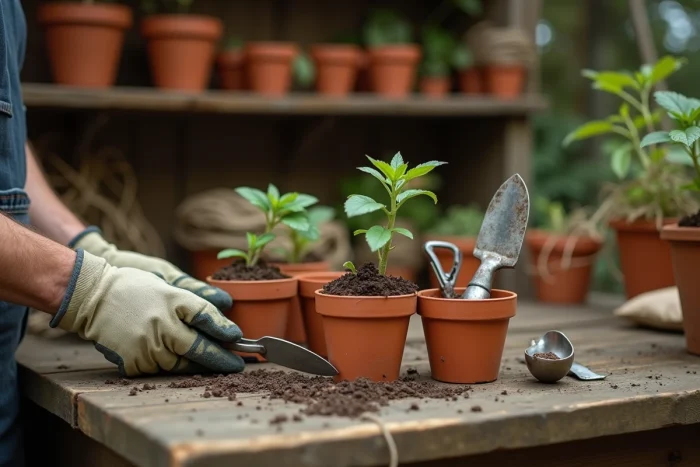
A bed composed solely of round-leaved plants appears monotonous. Alternating airy grasses (miscanthus, pennisetum) with broad-leaved perennials (hostas, bergenias) and compact shrubs (abelia, dwarf pittosporum) creates a visual contrast that structures the space without additional maintenance effort.
Three to four different types of foliage per bed are sufficient to create an impression of richness. Beyond that, the result becomes confusing and complicates management. Field feedback varies on the optimal number, but the rule of three contrasting textures remains a reliable guideline for most gardens.
Drainage and water recovery: two often-overlooked technical points
Poorly drained soil causes persistent puddles, promotes root diseases, and makes certain areas impassable after each rain. Before any planting, checking the soil’s infiltration capacity avoids costly corrections later. On clayey terrain, light drainage (a gravel trench at the back of the bed) often suffices to improve the situation.
Rainwater recovery, even with a simple collector on a downspout, provides a free and non-limestone resource for watering demanding areas. A water collector coupled with drip irrigation makes watering almost autonomous on small surfaces.
These two setups, drainage and recovery, are not about decoration but about the garden’s infrastructure. Integrating them from the design phase avoids having to uproot and rework the soil afterward.
An easy-to-maintain garden is not declared by choosing a list of miracle plants. It is built by a plan that respects the logic of the land, groups plants by needs, limits care-intensive surfaces, and layers elements so that each protects the others. Available data on climate-resilient gardens confirms that this structural approach withstands climatic uncertainties better than purely decorative arrangements.