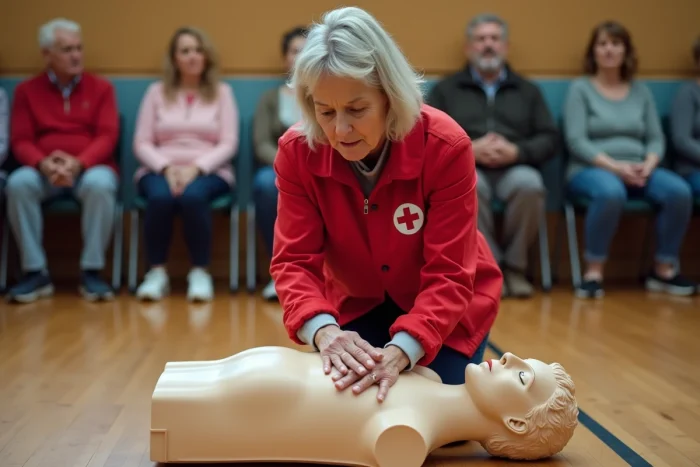
The three P’s of first aid, Protect, Prevent (alert), and Provide assistance, form a sequential protocol that conditions any emergency intervention. Each step depends on the previous one: without prior protection, the alert is rushed, and without a proper alert, the technical gesture loses effectiveness. Understanding this sequence as a logical chain, rather than a list of isolated reflexes, changes the quality of the intervention.
Why the order Protect, Alert, Assist conditions survival
The first P (Protect) aims to neutralize the danger before any contact with the victim. In a road accident, this means marking the area, cutting off the vehicle’s ignition, and keeping onlookers away from the risk of fire or electrocution. Acting on the victim while the danger persists exposes the rescuer and worsens the situation.
The second P (Prevent, meaning alert) involves providing a precise report to emergency services. A call to 15 (SAMU), 18 (firefighters), or 112 (European emergency number) must indicate the exact location, the number of victims, the nature of the observed problem, and the actions already taken. A clear report over the phone speeds up the dispatch of appropriate resources.
The third P (Provide assistance) only comes into play after these two steps. It encompasses the technical gestures appropriate to the victim’s condition: placing in recovery position, applying pressure to a hemorrhage, performing CPR. Mastering essential first aid gestures requires adhering to this sequence, not rushing into the technical gesture.
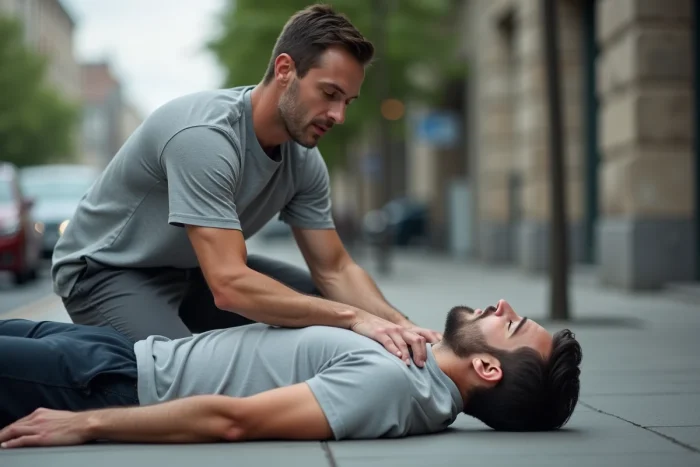
Protecting the accident scene: mistakes that worsen the situation
Protection of the scene is the phase most often rushed by witnesses. On the road, most secondary accidents arise from the lack of signage. A warning triangle placed too close to the crashed vehicle does not give approaching drivers time to brake.
Three concrete elements to check before touching a victim:
- Is the danger still active (fuel leak, electric wires on the ground, toxic smoke, unredirected traffic)? If so, the priority is to eliminate or bypass this danger, not to approach the victim.
- Does the rescuer have a high-visibility vest and a means of marking the area? For drivers, recent training content on road safety reminds them of the legal obligation to provide assistance, as well as the obligation not to create a second accident.
- Can the victim be moved without risk? Unless there is an immediate life-threatening danger (fire, drowning), a wounded person should not be moved until professional help arrives, due to the risk of exacerbating a spinal injury.
Alerting emergency services: which emergency number and what report to provide
15 directs to medical regulation, 18 to firefighters, and 112 works throughout the European Union, even without the usual operator’s network. For deaf or hard of hearing individuals, 114 allows contact via SMS.
The operator on the phone asks specific questions. Providing a structured report saves time: location (address, kilometer point, visual landmark), number of victims, apparent condition (conscious or not, breathing or not, bleeding heavily or not), actions already taken. Hang up only when the operator allows it, as they may guide the performance of actions while waiting for the team to arrive.
The special case of children and infants
When the victim is a child or an infant, notifying the operator immediately changes the type of team sent. The maneuvers for clearing the airways differ by age: turning an infant onto the forearm and delivering back blows for an infant, adapted Heimlich maneuver for a child over one year old. Training organizations are now developing targeted modules by audience (young children, seniors, sports clubs) with content specific to each age group.

Automated external defibrillator: an accessible gesture without training
The automated external defibrillator (AED) analyzes the heart rhythm and delivers an electric shock only if necessary. The device vocally guides each step, from placing the electrodes to the moment of shock. Any witness is legally allowed to use an AED without prior training.
The widespread deployment of these devices in public spaces and workplaces, encouraged in recent years by recommendations from the French Council for Cardiopulmonary Resuscitation, aims to reduce the time between cardiac arrest and the first shock. This time is the most determining factor for survival: every minute that passes without defibrillation or CPR significantly decreases the chances of recovery.
CPR and AED: a duo, not an alternative
The AED does not replace CPR. In practice, a witness starts chest compressions immediately while another goes to fetch the nearest defibrillator. Compressions should only stop for electrode placement and during rhythm analysis. Alternating compressions and defibrillation maximizes the chances of cardiac recovery.
Short first aid training: PSC1 and GQS format
The PSC1 (Prevention and Civic First Aid Level 1) remains the reference training, provided by the Red Cross, Civil Protection, and many local authorities. It covers all common emergency situations in one day.
For those who do not have that much time, the “Gestes Qui Sauvent” (GQS) format condenses essential gestures into two hours: protection, quick examination, alert, actions to take in case of hemorrhage, waiting positions. This short format meets a growing demand and allows reaching people who would never have signed up for a long training course.
The sequence Protect, Alert, Assist is not an acronym to recite; it is an order of actions whose non-compliance renders subsequent gestures less effective, even dangerous. Taking a training course, even for two hours, instills this automatic response better than any reading.