An entertainment preparatory course is not just a drawing upgrade. It is a technical filter that determines the student’s future specialization, production pace, and ability to survive the four years of higher education in 3D animation, VFX, or video game design.
Real-time 3D and Gaussian splatting: the skills that the preparatory course must anticipate
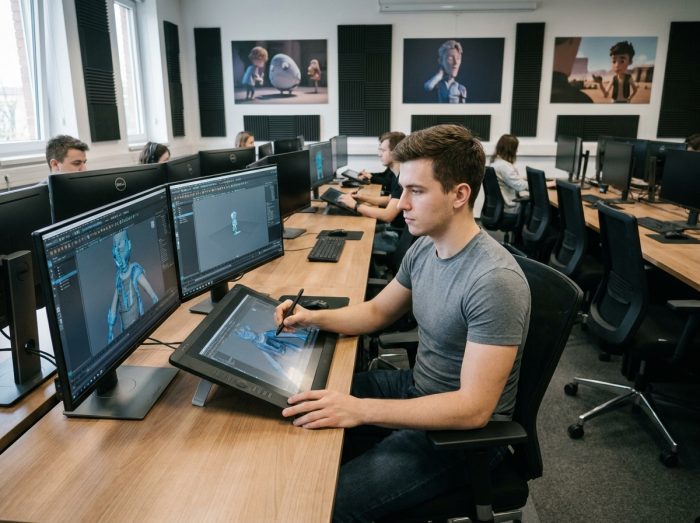
French 3D animation programs now heavily integrate Unreal Engine and real-time workflows. An entertainment preparatory course that limits itself to academic drawing and traditional sculpture misses the mark. French preparatory courses surpass their Canadian counterparts in focusing on real-time 3D with Unreal Engine, according to the SIGGRAPH 2025 report on VFX training trends.
This advantage comes at an educational cost. The preparatory year must simultaneously cover fundamental artistic skills (perspective, anatomy, color) and an introduction to digital production tools. Technical workshops combine storyboarding, digital illustration, and initial hands-on experience with 3D engines.
To understand the role of an entertainment preparatory course in this context, one must measure the gap between a high school graduate entering directly into the program and a student who has spent a year structuring their visual culture and work pipeline.
Gaussian splatting, a 3D rendering technique based on Gaussian point clouds, is beginning to appear in advanced curricula. A preparatory course that familiarizes its students with this type of paradigm, even in an introductory way, gives them a concrete advantage by the second year.
Overproduction of junior VFX profiles: the risk that schools do not highlight
The VFX market in Montreal, long a preferred destination for French graduates, has been experiencing significant contraction for several years. Studios are reducing their permanent staff in favor of short contracts and automated pipelines. Nearly one-third of animation graduates are transitioning to creative technology, according to the perspective raised by the SIGGRAPH 2025 analysis.
Creative technology encompasses hybrid positions: interactive installations, immersive experiences for retail, XR prototyping. These jobs require skills that the entertainment preparatory course can provide if it includes:
- An introduction to creative coding (TouchDesigner, Processing) in addition to drawing and sculpture
- Multidisciplinary projects that combine visual storytelling and user interaction
- A culture of uses beyond cinema: museography, events, immersive architecture
Preparatory courses that remain solely focused on the cinema pipeline produce profiles that the market no longer needs in volume. The preparatory year must broaden the spectrum of opportunities, not narrow it down to a single sector under pressure.
Qualiopi certification and funding: what changes for entertainment preparatory courses in 2024
The extension of Qualiopi certifications to entertainment preparatory courses, documented by the Ministry of Labor in its official bulletin of November 15, 2024, transforms the landscape. These programs become eligible for CPF, opening the door to funded professional retraining.
For schools, obtaining Qualiopi requires a structured educational framework with measurable objectives, formal evaluations, and post-training follow-up. Preparatory courses that operated on a free workshop model must rethink their educational engineering.
For students in retraining, the consequence is direct: a preparatory year in applied arts and animation, previously self-funded, can now be partially or fully covered. This changes the profile of the cohorts, with older students, often more motivated, but whose expectations regarding professional integration are more immediate.
Workload and educational rhythm: the four or five-year curriculum
ESMA has evolved the total duration of its program, extending it from four to five years in certain configurations. Marie Pillier, an animator at Rodeo FX in Montreal and an ESMA alumna, emphasizes in an interview on esma-3d.fr that this extension promotes creative experimentation rather than a race for production.
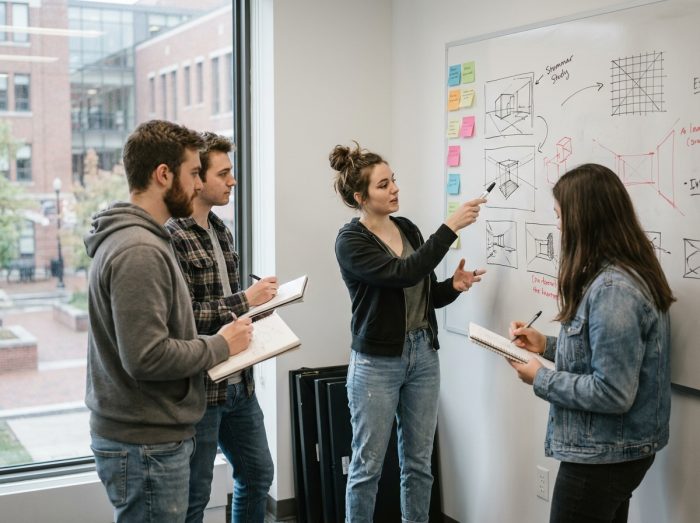
The entertainment preparatory course absorbs some of this pressure. By concentrating the artistic fundamentals into a dedicated year, it frees up time in the higher education cycle for specialization projects. Continuous assessment, combined with SAEs (learning and evaluation situations) at the end of the semester, validates transversal skills in conditions close to the professional context.
We observe that students who have followed a structured preparatory course manage the technical workload of the second and third years better. Observation drawing, mastery of color, and volume practice are not pedagogical luxuries: they are the foundations upon which all modeling, texturing, and layout work rests.
American bootcamps or French preparatory courses: two philosophies of integration
American bootcamps prioritize rapid integration, with training lasting three to six months focused on a specific software or pipeline. Their flexibility is appealing, but they produce operational profiles for a single task, not versatile artists.
The French entertainment preparatory course takes the opposite approach. A full-time, in-person year with a broad foundation:
- Academic and digital drawing (observation, anatomy, perspective)
- Sculpture and volume for spatial understanding
- Storyboarding and sequential narration
- Artistic culture and image analysis
This broad foundation slows entry into the job market but protects against technical obsolescence. An artist who understands light, volume, and storytelling can adapt to any engine or pipeline. An operator trained on a single tool becomes obsolete when that tool changes.
The choice between these two models depends on the goal. For a quick transition to a production position, the bootcamp may suffice. To build a long-term career in animation, video games, or creative technology, the entertainment preparatory course remains the most solid foundation, provided it has integrated market changes into its curriculum.