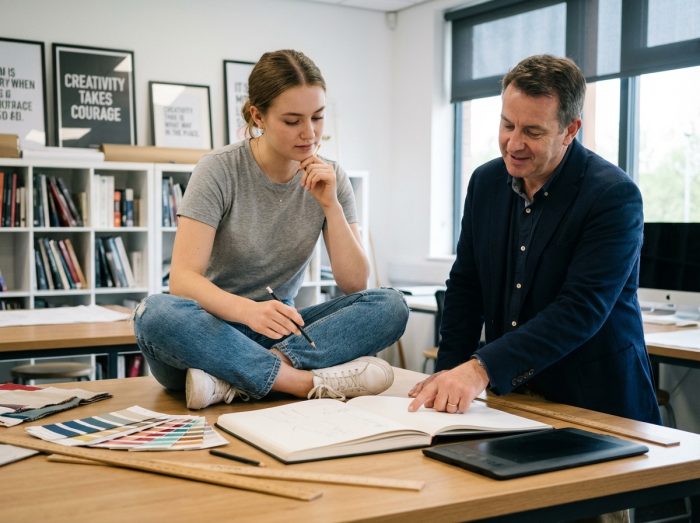
The numbers are stubborn: less than 15% of graphic designers recruited in agencies learned their trade on their own, without supervision. The rest? They almost all come from structured training programs, with a recognized diploma and a tailored portfolio, validated by precise standards. Specialized schools leave no room for improvisation: regular production, pressure to deliver, concrete requirements. Solitary learning, while admirable, does not impose the same tempo or solidity.
This educational framework is not an abstract promise: it is experienced day after day, through sharp feedback, access to professional software, and exercises aligned with real-world scenarios. Internships and work-study programs do not just serve to fill out a resume. They accelerate entry into the profession, hasten the assumption of responsibilities, and allow one to test their skills against real clients.
Overview of Digital Studies After High School: What Paths to Initiate into Graphic Design?
After high school, the offer of training in graphic design has become denser. The BTS in graphic design, still highly sought after, unfolds over two years where technical courses, workshops on visual communication, and progressive immersion follow one another. Some schools have focused on a preparatory year: a semester to establish the foundations before starting in-depth projects.
At the same time, universities offer a more theoretical option, with an emphasis on research or image analysis, a path appreciated by those drawn to teaching or art theory. However, specialized schools remain attractive for their daily support, the construction of the portfolio aided by professionals, and their network of alumni still in the field.
Here is an overview of the options available after high school:
- BTS in graphic design: quick access to the professional world, integrated internship, operational training
- Bachelor’s in applied arts or visual communication: general approach, possibilities to pivot to other creative sectors
- Private specialized schools: project-oriented pedagogy, industry professionals as instructors, step-by-step portfolio development
To concretely measure the impact of graphic design training for a beginner, one only needs to look at the ability to enter the codes of the profession, to anticipate what agencies are looking for, and to adapt to ever-evolving practices and constraints. Following a structured curriculum means accepting to confront the demands of professionals, to push one’s own limits, and to anchor oneself in a sector that does not tolerate half-measures.
Why Does Structured Training Really Transform Graphic Design Learning?
Choosing a structured training in graphic design means stepping out of one’s comfort zone. Here, everything is organized around a teaching team that closely follows progress, sets deadlines, corrects deviations, values technical successes, and helps overcome difficult milestones. Concrete projects punctuate the year: from the imposed brief to the final layout, each work confronts the expectations of the professional world. It is impossible to settle into pure theory: each project is a new step, each feedback moves one forward.
Working in groups also means learning to argue, to receive criticism, to stand firm, and to listen. Discussions led by a project manager or facilitated by an executive assistant change the game: they cultivate boldness, analysis, and respect for deadlines. Educational outings, interventions by practicing graphic designers, and access to specialized workshops give a real added value to the curriculum.
On the ground, it is observed that this type of structured training allows:
- To engage in concrete projects and work in real conditions
- To benefit from support by active professionals in the field
- To open doors to the professional world through a solid network
- To acquire methods and reflexes on layout tools
Nothing is left to chance. The graphic design profession is built on endurance, repetition, and ongoing dialogue with the vibrant world of visual communication and the arts professions. A well-structured curriculum does not just transmit knowledge: it shapes future professionals confident in their methods and vision.

Work-Study, Distance Learning, or In-Person: How to Choose the Right Format for Your Creative Project
Graphic design is taught in multiple formats, each influencing the pace and level of autonomy. Work-study encourages immersion: one foot in school, the other in the agency, constantly shifting between theory and practice. As a result, project management, layout, and the use of graphic software become reflexes, driven by the dynamics of the field.
Distance learning, on the other hand, appeals to those juggling constraints or prioritizing independence. Online training platforms combine videos, practical work, tailored feedback, and self-managed modules. To progress, one must learn to discipline themselves, plan, and maintain a rhythm: here, autonomy is both an ally and a challenge.
Three modalities stand out, to be chosen according to temperament and project:
- Work-study: field experience, rapid skill development, immediate professional network
- Distance learning: freedom of organization, expanded access to resources, personal time management
- In-person: collective dynamics, constant exchanges, feedback from peers and instructors
In-person learning focuses entirely on collective engagement and direct stimulation: discussions, practical workshops, real-time critiques. Before making a decision, consider the reality of your project, your expectations, and the most effective way to learn over time. Choosing your training format is already the first step in shaping your creative posture, laying the foundation for the path ahead.